
 EN
EN  English
 中文简体
中文简体 عربى
عربى Tiếng Việt
Content
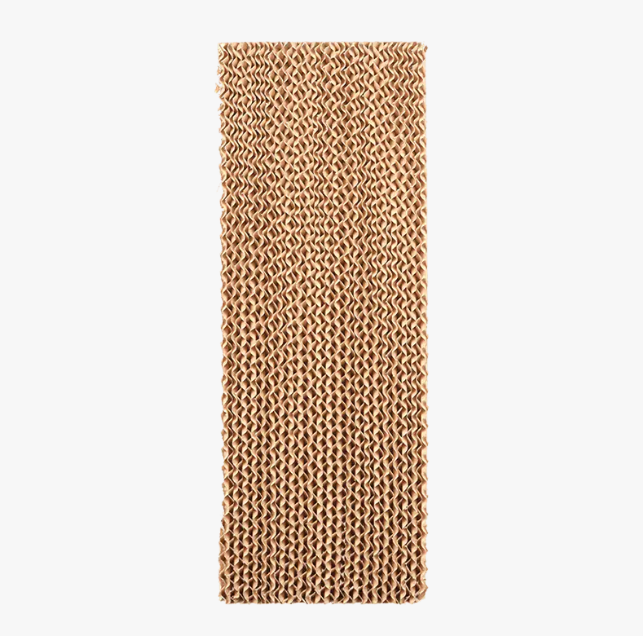
The normal service life of evaporative cooler cooling pads in evaporative coolers is typically 1–3 years, while industrial-grade high-quality cooling pads can operate stably for 3–5 years. The actual lifespan depends on multiple factors such as water quality, usage frequency, dust levels in the environment, maintenance practices, and pad material structure. Therefore, cooling pads do not have a fixed universal lifespan but rather a practical service range.
Key factors affecting cooling pad lifespan
The aging of cooling pads is caused by multiple combined factors, including: Water hardness and impurity content, Airborne dust and pollution levels, Operating frequency and daily running time, Material density of the cooling pad, Cleaning and maintenance cycles, Filtration and system design. These factors directly determine the rate of clogging and structural degradation.
Lifespan differences by cooling pad type
Standard paper cooling pads
Lifespan: 1–2 years;Advantages: Low cost, good water absorption;Disadvantages: Scale buildup, mold growth, easy degradation.
High-density honeycomb cooling pads
Lifespan: 2–3 years;Features: Stable structure, high cooling efficiency;Applications: Commercial evaporative coolers.
Industrial resin-reinforced cooling pads
Lifespan: 3–5 years;Features: Corrosion resistance, anti-scaling, anti-mildew;Applications: Industrial evaporative cooling systems.
Signs of cooling pad aging
Heavy surface scaling, Structural softening or deformation, Strong unpleasant odors, Decreased cooling efficiency, Uneven water distribution. Continued use under these conditions will reduce cooling performance and increase energy consumption.
Cooling pad lifespan reference data
| Type | Water quality | Application scenario | Average lifespan |
| Standard cooling pad | Normal water | Household/ small commercial | 1–2 years |
| Honeycomb cooling pad | Filtered water | Commercial | 2–3 years |
| Industrial cooling pad | Softened/purified water | Industrial systems | 3–5 years |
Practical ways to extend cooling pad lifespan
Regular descaling and rinsing (every 1–2 months recommended), Use filtered or softened water, Install pre-filtration systems, Clean the water tank regularly, Dry the pads thoroughly during long shutdown periods, Avoid long-term high-load operation. With scientific maintenance, service life can be extended by over 30%.
Cooling pads replacement indicators
Cooling pads should be replaced even before their theoretical lifespan if you observe: Significant drop in cooling performance, Reduced outlet air temperature difference, Noticeable increase in energy consumption, Uneven water distribution, Structural damage or collapse.
Key indicators when choosing durable cooling pads
Material density, Anti-mildew and anti-corrosion treatment processes, Honeycomb structure strength, Uniform water absorption, Brand quality certifications. High-quality cooling pads not only last longer, but also provide more stable cooling efficiency.
The service life of evaporative cooler cooling pads is generally 1–3 years, while high-quality industrial-grade pads can last 3–5 years. Their lifespan is not fixed but is closely related to water quality, environment, operating intensity, and maintenance practices. From a system cost perspective, choosing high-quality cooling pads and performing proper maintenance is more economical and stable than frequently replacing low-quality pads.

 CONTACT US