
 EN
EN  English
 中文简体
中文简体 عربى
عربى Tiếng Việt
Content
- 1 Core Material Types and Structural Principles
- 2 Key Performance Metrics Comparison
- 3 Efficiency Degradation Mechanisms in Real-World Operation
- 4 Selection Strategy: Matching Materials to Application Scenarios
- 5 Maintenance Protocols for Sustaining Peak Efficiency
- 6 Critical Yet Often Overlooked Design Details
- 7 Market Trends and Technology Evolution
For the vast majority of commercial and industrial evaporative cooling systems, honeycomb rigid cellulose pads (Cellulose Rigid Media) represent the optimal choice for balanced performance. Under standard operating conditions, they achieve saturation efficiencies of 80%–95%, bringing outlet air temperatures within 3–8°F (1.7–4.4°C) of the wet-bulb temperature while maintaining a stable service life of 3–5 years. In extreme environments with high dust, strong corrosive agents, or limited maintenance access, synthetic media (Synthetic Media) offers a more pragmatic alternative due to superior mechanical longevity and fouling resistance. Traditional aspen/wood fiber pads (Aspen/Excelsior) are only suitable for budget-constrained, low-usage residential applications.
Core Material Types and Structural Principles
The fundamental function of evaporative cooler pads is to create maximum water-air contact area within an airstream while achieving uniform water distribution through capillary action. Current mainstream materials fall into three categories, with their internal structures directly determining heat transfer efficiency and durability.
Wood Fiber Pads (Aspen/Excelsior)
Composed of natural aspen wood shavings compressed into a random fiber matrix held by netting. Wide variation in fiber diameter and packing density creates a broad pore distribution. Advantages include strong initial hydrophilicity, excellent capillary action, and low pressure drop; however, fibers expand and contract during wet-dry cycling, leading to structural loosening. They are also vulnerable to microbial degradation and UV damage. Typically used in residential window coolers, they represent the lowest-cost but shortest-lifespan option.
Rigid Cellulose Pads (Cellulose Rigid Media)
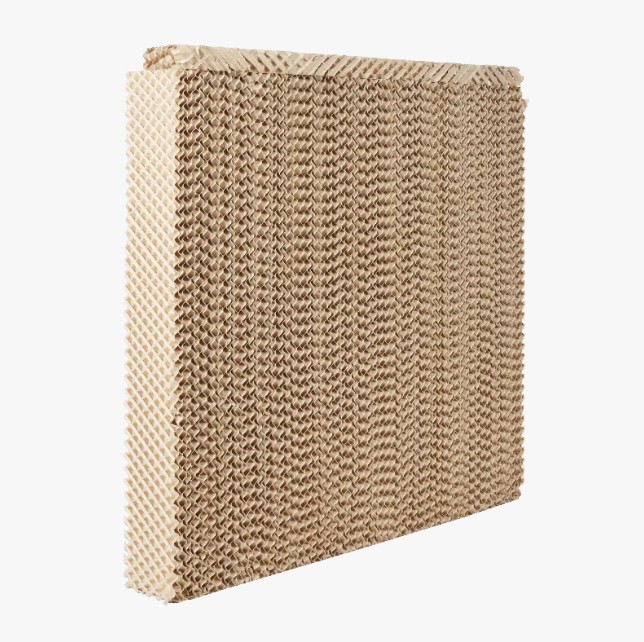
Constructed from cross-corrugated cellulose paper layers, commonly featuring honeycomb channels at 45°/15° angles. This geometric design creates predictable airflow passages, enabling counter-flow or cross-flow patterns between air and water that maximize surface renewal rates. Chemically treated surfaces enhance wettability and resist water erosion, while edge reinforcements facilitate modular installation. High geometric stability prevents deformation under wind and water pressure loads.
Synthetic Media Pads
Manufactured from polyester, polyethylene, polypropylene, or polyurethane substrates, with structures ranging from open-cell foam to layered mesh or extruded lattices. Untreated polymers are typically hydrophobic and require hydrophilic coatings or surfactants to improve wettability. Exceptional geometric stability resists crushing and wet-dry cycling, while inherent resistance to rot and microbial growth makes them ideal for chlorine-rich, high-dust, or long-maintenance-cycle industrial environments. Initial thermal efficiency is typically slightly lower than equivalent-grade cellulose pads.
Key Performance Metrics Comparison
Cooling pad evaluation must rely on quantified thermodynamic and fluid dynamic metrics rather than subjective impressions. The following table presents typical performance ranges for the three material categories at equivalent face velocities (300–550 fpm, approximately 1.5–2.8 m/s).
| Performance Metric | Wood Fiber Pads | Rigid Cellulose Pads | Synthetic Media Pads |
|---|---|---|---|
| Saturation Efficiency (η) | 60%–85% | 80%–95% | 70%–90% |
| Approach to Wet-Bulb Temp (ATWB) | 8–12°F (4.4–6.7°C) | 3–8°F (1.7–4.4°C) | 5–10°F (2.8–5.6°C) |
| Typical Service Life | 1–2 Cooling Seasons | 3–5 Years | 5–7+ Years |
| Pressure Drop Stability | Prone to dust clogging increase | Moderate and predictable | Most stable |
| Biofouling Resistance | Weak, algae-prone | Moderate | Strong |
| Cleanability | Low-pressure rinse only | Mild chemical cleaning | Tolerates aggressive cleaning |
As shown in the table, rigid cellulose pads achieve the optimal balance between cooling efficiency and cost-effectiveness, which explains their dominant market share in the global evaporative cooling sector. While synthetic pads may have slightly lower peak efficiency, their total lifecycle cost in extreme environments can be significantly lower.
Efficiency Degradation Mechanisms in Real-World Operation
Even with high-performance materials, cooling efficiency can decline significantly within weeks if maintenance is neglected. Understanding the three primary degradation mechanisms is essential for sustaining peak system performance.
Scaling
As water evaporates, calcium and magnesium minerals deposit on pad surfaces, forming scale. When water conductivity exceeds threshold levels, calcium carbonate and magnesium hydroxide rapidly precipitate on warm evaporative surfaces, blocking honeycomb channels. Research indicates that in systems without blowdown management, pressure drop can increase by 20%–40% within one month, with saturation efficiency declining by 5–15 percentage points.
Biofouling
Algae and bacteria form biofilms that not only increase airflow resistance but also degrade cellulose and wood fiber substrates. In poultry farms and greenhouses, biofilm blockage can cause localized pad drying, creating "hot spots" with uneven outlet temperatures. In severe cases, efficiency losses can exceed 30%.
Particulate Loading
Airborne dust, pollen, and fibers accumulate deep within pad structures, particularly affecting the random pore structure of wood fiber pads. In mining or agricultural environments, high dust loads can double wood fiber pad pressure drop within weeks and trigger channeling, where air bypasses wetted regions entirely.
Selection Strategy: Matching Materials to Application Scenarios
Material selection should never be made in isolation. It must integrate climate conditions, water quality, maintenance accessibility, and process criticality. The following recommendations address four typical scenarios.
Residential and Light Commercial Window Coolers
If budget is severely constrained and maintenance is convenient, wood fiber pads remain usable, but accept the reality of replacement every 1–2 seasons. A more recommended approach is upgrading directly to 4–6 inch thick rigid cellulose pads. While initial investment increases by approximately 2–3x, cooling efficiency improves by 10–20%, and frequent replacement labor costs are eliminated.
Commercial and Industrial Central Air Conditioning Systems
Rooftop units and centralized evaporative cooling systems should be equipped with 6–12 inch thick honeycomb cellulose pads, complemented by intelligent conductivity control and automatic blowdown. In hot-dry climate zones (wet-bulb temperatures below 20°C), an 8-inch pad at 450 fpm face velocity can reduce 105°F (40.6°C) inlet air to 69–71°F (20.6–21.7°C), approaching the wet-bulb temperature by only 4–6°F.
Remote, High-Dust, or Maintenance-Limited Sites
Mining operations, remote agricultural facilities, or telecom base stations face extremely high maintenance mobilization costs. In these scenarios, synthetic media pads should be selected. Their crush resistance, chemical corrosion resistance, and biofouling resistance can reduce annual maintenance labor by over 50%. If efficiency gaps need compensation, increased pad thickness or reduced face velocity can be implemented.
Corrosive or Strong Oxidizer Environments
In food processing facilities, pool equipment rooms, or environments with chlorinated water sources, cellulose pad adhesives and resins are susceptible to softening and delamination by oxidizers. Synthetic polymer pads maintain structural integrity in such conditions, but specific resin types must be verified for chemical compatibility to avoid long-term exposure causing polymer embrittlement.
Maintenance Protocols for Sustaining Peak Efficiency
Cooling pad maintenance is not simply "rinsing" but a systematic engineering process based on water chemistry, mechanical cleaning, and seasonal protection. The following steps can be incorporated into Standard Operating Procedures (SOP).
Water Quality and Blowdown Management
Implement continuous bleed to maintain concentration cycles below scaling thresholds. Use conductivity sensors to automatically regulate blowdown valves, typically targeting conductivity below 80% of the local water quality scaling critical value. Perform complete sump drainage and refill at least monthly to reset total dissolved solids (TDS) accumulation.
Pad Cleaning Operations
- Wood fiber pads: Rinse only from the air outlet side with low-pressure water; avoid high pressure that tears fibers. If pads have collapsed or shed significantly, replacement is more economical than deep cleaning.
- Cellulose pads: Rinse from the air outlet side; for light scale, use diluted citric acid or phosphoric-based descalers (per manufacturer concentration). Limit contact time to avoid resin corrosion.
- Synthetic pads: Tolerate soak-rinse cycles and most disinfectants, but verify resin-chemical compatibility; open-cell foam structures permit more aggressive cleaning without geometric damage.
Biofilm Control
Maintain free chlorine or bromine residuals in the sump within manufacturer-recommended ranges, or use non-oxidizing biocides per specifications. Ensure drift eliminators are intact to minimize aerosol-borne biocide exposure to downstream spaces. Biofilms once formed deep within pad structures are rarely eradicated by surface rinsing alone and often require chemical immersion.
Seasonal Shutdown Protection
After the cooling season, completely drain sumps, pumps, and filters. Run the fan briefly in dry mode to blow moisture from the pads, preventing mold growth during winter dormancy. Cover units with dust shields to block UV radiation and particulate intrusion. For cellulose and wood fiber pads, long-term dry storage significantly reduces microbial activity.
Critical Yet Often Overlooked Design Details
Many efficiency losses stem not from pad material quality but from mismatched system design parameters and pad characteristics. The following five details often determine real-world performance more than brand labels.
- Face velocity matching: Each pad material has an optimal "sweet spot." Excessive velocity causes water carryover and wet-bulb approach degradation; insufficient velocity wastes fan power. For rigid cellulose systems, design face velocity is typically controlled at 350–550 fpm (1.8–2.8 m/s), verified against manufacturer performance curves.
- Pad thickness and climate matching: Hot-dry regions should use 6–12 inch thick pads to increase air residence time; moderate climates can use 4–6 inch thin pads to reduce pressure drop and cost.
- Water distribution uniformity: "More water is better" is a common misconception. Excessive flow causes channeling and re-entrainment. Use manufacturer-recommended gpm per linear foot, ensuring top distribution pipes are level and nozzles are unobstructed.
- Upstream air filtration: Installing pre-filters at air inlets can reduce dust loading by 60%–80%, significantly delaying pressure drop drift and extending pad life across all material types.
- Building airtightness: For negative-pressure fan-pad systems, buildings must maintain airtight integrity. Any unplanned openings (cracks, door/window gaps) become low-resistance bypass channels for hot air due to pad pressure drop (typically 0.05–0.10 inches water column), severely undermining cooling effectiveness.
Market Trends and Technology Evolution
The global evaporative cooler market was valued at approximately $3.8 billion in 2025 and is projected to reach $8.5 billion by 2036, representing a compound annual growth rate (CAGR) of 8.4%. Growth drivers include rising global temperatures, escalating energy costs, and demand for environmentally friendly cooling solutions. Cellulose pads, leveraging high absorbency, durability, and superior cooling efficiency, captured the largest share of the cooling media market in 2026.
Technologically, IoT sensors are being integrated into modern evaporative cooling systems to monitor airflow, wet-bulb temperature, and water quality in real time, with predictive maintenance algorithms issuing alerts before failures occur. Anti-algae coatings and anti-mineral treatments have extended the service life of some premium pads by 30%. Additionally, hybrid systems combining evaporative cooling with solar photovoltaic arrays are emerging, further offsetting operational energy consumption and carbon footprint. These innovations are transforming evaporative cooler pads from simple mechanical components into intelligent, adaptive thermal management nodes.

 CONTACT US