
 EN
EN  English
 中文简体
中文简体 عربى
عربى Tiếng Việt
Content
In the sweltering summer, evaporative cooling fans are often a popular choice when looking for economical and efficient cooling solutions.
How Evaporative Cooling Fans Work
To understand their performance at high temperatures, we must first understand their core mechanism.
Evaporative cooling fans utilize the natural process of water evaporation carrying away heat from the air.
Intake of Hot Air: The fan draws hot air from the surrounding air into the machine.
Wetting the Cooling Pad: Air passes through a honeycomb cooling pad (or wet curtain) soaked in water.
Evaporative Cooling: When water changes from a liquid to a gaseous state (evaporation), it absorbs a large amount of heat energy from the surrounding air; this process is called the heat of vaporization.
Outflow of Cool Air: The fan then blows the cooled and humidified air back into the room.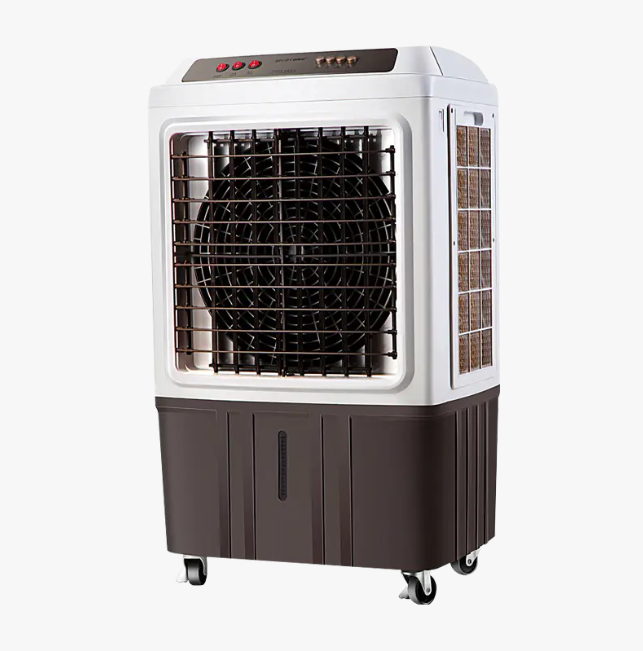
Performance at High Temperatures: Humidity is Key
Temperature and humidity are two key factors determining the effective operation of an evaporative cooling fan.
Temperature:
For evaporative cooling fans, higher temperatures are better.
High temperatures accelerate the evaporation process of water, theoretically meaning the equipment has greater cooling potential.
Humidity:
Ideally, lower humidity is better.
In high-humidity environments, the air is near saturation, which greatly limits water evaporation. When evaporation is limited, the actual cooling effect of the evaporative cooling fan is significantly reduced.
High Temperatures in Dry Regions: Excellent Performance
In dry climates (humidity below 40%), such as parts of northern or western China, even at temperatures above 35 degrees Celsius, there is still ample space in the air to hold more water vapor. Therefore, evaporative cooling fans can maintain a high evaporation rate, achieving cooling reductions of 5 to 15 degrees Celsius, performing exceptionally well.
Challenges in Humid Regions: Limited Effectiveness
In humid climates (humidity above 70%), such as coastal areas of southern China, the air is near saturation. In this case, the cooling effect of the evaporative cooling fan is significantly reduced. They can still generate airflow, but due to limited evaporation, the air is only slightly cooled, while increasing indoor humidity, potentially making people feel even more stuffy and uncomfortable.
Tips for Maximizing Evaporative Cooling Fan Efficiency
If you are using an evaporative cooling fan in a high-temperature environment, be sure to follow these usage tips:
Maintain Ventilation: Unlike air conditioners, evaporative cooling fans require ventilation. Opening a door or window to allow humid air to escape and fresh, dry air to enter maintains efficient evaporation circulation, which is key to ensuring good cooling performance.
Use Cold Water or Ice: Adding ice or chilled water to the tank can provide additional immediate cooling in the short term, but note that this does not fundamentally change the evaporation principle.
Regular Cleaning: Regularly clean the tank and cooling pads to prevent scale and mold from affecting evaporation efficiency and air quality.
Will it still work?
The answer is: Yes, but the effect depends on the ambient humidity.
In hot and dry environments, evaporative cooling fans are a very effective cooling solution.
In hot and humid environments, its cooling effect is very limited; it is recommended to consider using a traditional air conditioner.
When purchasing cooling equipment, please be sure to make the most suitable choice based on the climate characteristics of your region to ensure optimal comfort during hot weather.

 CONTACT US