
 EN
EN  English
 中文简体
中文简体 عربى
عربى Tiếng Việt
Content
On a 38°C dry-bulb day with a 24°C wet-bulb temperature, a cooling pad running at 90% saturation efficiency can deliver air at roughly 25°C. The same system at 65% saturation efficiency will deliver air at about 29°C. That four-degree gap translates directly into poultry house productivity, worker comfort, or greenhouse crop quality.
Saturation efficiency is the metric that tells you how much of the theoretical cooling potential a pad actually delivers. It is not a lab-only number. It is the basis for selecting pad thickness, choosing face velocity, comparing materials, and predicting fan energy use. Below, we explain what saturation efficiency means, the variables that drive it, and how to use it when buying cooling pads.
What Saturation Efficiency Means
Saturation efficiency — also called saturation effectiveness — is a dimensionless number showing how close the air exiting a cooling pad is to its theoretical limit, the wet-bulb temperature of the incoming air.
The Saturation Efficiency Formula
η = (Tin - Tout) / (Tin - Twb) × 100%
Where Tin is the dry-bulb temperature of incoming air, Tout is the dry-bulb temperature of outgoing air, and Twb is the wet-bulb temperature of incoming air. At 100% saturation efficiency, the outgoing air is fully saturated with moisture and exactly equal to the wet-bulb temperature. Real pads typically achieve 60% to 95%, depending on design and operating conditions.
Key Factors That Drive Saturation Efficiency
Four variables dominate the saturation efficiency of a honeycomb cooling pad: face velocity, pad geometry, water distribution, and pad material.
Face Velocity
Face velocity is the speed at which air passes through the pad face, measured in meters per second. Lower face velocity gives air more contact time with the wetted surface, so saturation efficiency rises. Higher face velocity increases total cooling capacity but reduces the percentage of saturation achieved. Most rigid cellulose pads are designed for 1.0 to 2.5 m/s face velocity.
A pad rated at 2.5 m/s with 68% efficiency may move more air than a pad rated at 1.5 m/s with 82% efficiency. Your choice depends on whether you need maximum air volume in the room or maximum cooling per cubic meter of airflow.
Pad Thickness and Flute Geometry
Thicker pads create a longer airflow path, which increases heat and moisture exchange. The honeycomb design of the cooling pad determines the internal structure that shapes this airflow. Specifications such as 5090, 6090, and 7090 indicate flute dimensions and corrugation angles that affect contact surface area and static pressure.
Water Distribution
Uniform wetting across the entire pad face is essential. Dry patches create local zones with near-zero evaporative cooling and severely reduce overall efficiency. Typical water circulation rates range from 0.75 to 1.5 L/min per meter of pad width, with thicker pads requiring the higher end of the range.
Real-World Efficiency Numbers by Material
Material choice sets a practical upper limit on saturation efficiency. Rigid cellulose honeycomb pads are engineered for high wettability and structural integrity. They consistently outperform aspen fiber, plastic mesh, or coconut coir under like-for-like operating conditions.
| Pad Material | Saturation Efficiency Range | Expected Temperature Drop | Typical Service Life |
|---|---|---|---|
| Cellulose honeycomb (rigid) | 85–95% | 12–14°C | 3–5 years |
| Aspen fiber | 68–81% | 9–11°C | 1–2 years |
| Plastic mesh | 55–70% | 7–9°C | 2–4 years |
| Coconut coir | 60–75% | 8–10°C | 1–3 years |
How to Get the Highest Efficiency from a Cooling Pad
Even the best pad will underperform if it is mismatched to the system. Four actions have the largest practical impact.
- Match face velocity to pad thickness. For a 150 mm pad, aim for 1.2 to 2.0 m/s. For a 300 mm pad, 1.5 to 2.5 m/s is a workable range.
- Verify water distribution. Check that the water distribution trough is level and the pump delivers enough flow across the entire pad face.
- Keep the pad clean. Mineral scale and airborne dust reduce the wetted surface area. Weekly rinsing and periodic chemical cleaning extend pad life and efficiency.
- Replace damaged pads. Even one broken flute channel creates an airflow bypass that lowers efficiency for the whole pad bank.
Efficiency vs. Operating Cost
A 5-percentage-point gain in saturation efficiency can reduce fan runtime in hot weather and lower water consumption. For a 1,000 m³/h system running 10 hours a day, that gain may save 3–5% of the system's annual electricity bill. Over a five-year pad service life, the savings often exceed the initial price difference between a standard pad and a high-performance rigid cellulose pad.
For retrofit or replacement projects in industrial and commercial evaporative cooling systems, the 5090 honey comb cooling pad is a widely used specification.
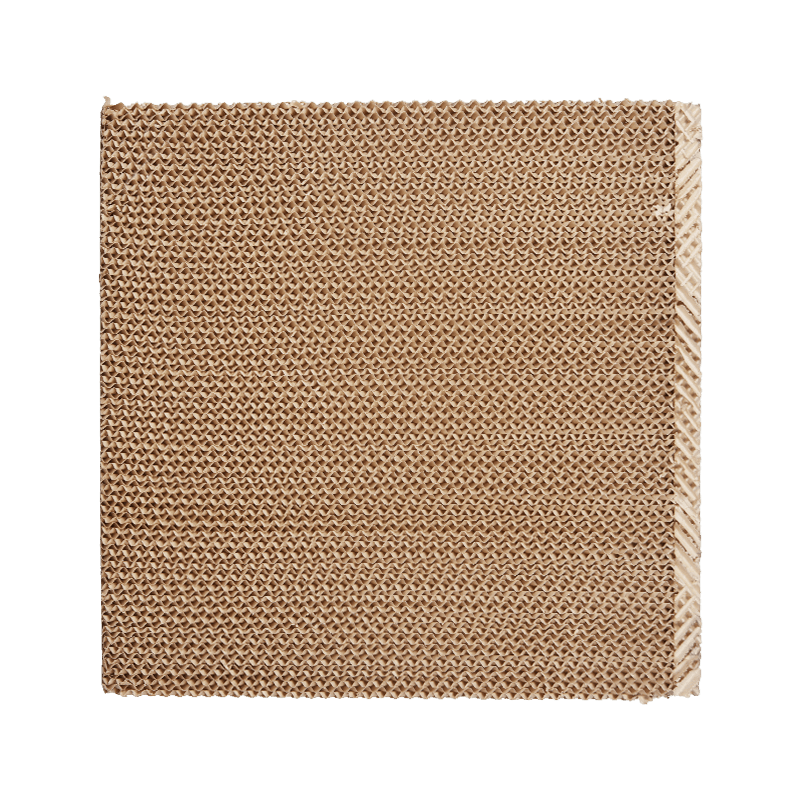 5090 Honeycomb Cooling Pad for Evaporative Cooling SystemsThis 5090 pad offers customizable height and width with depths of 50, 100, or 150 mm, featuring 5 mm flutes at 45° angles. It suits retrofit or replacement projects in industrial and commercial evaporative cooling.View Product →
Match the Pad to Your Application
Different industries need different pad profiles. The same saturation efficiency formula applies, but the target operating point changes.
Greenhouse Growing
Greenhouses typically run lower face velocities to maximize humidity and keep cooling uniform. The 7090 specification is common in this segment because the larger flute spacing reduces pressure drop across the pad bank.
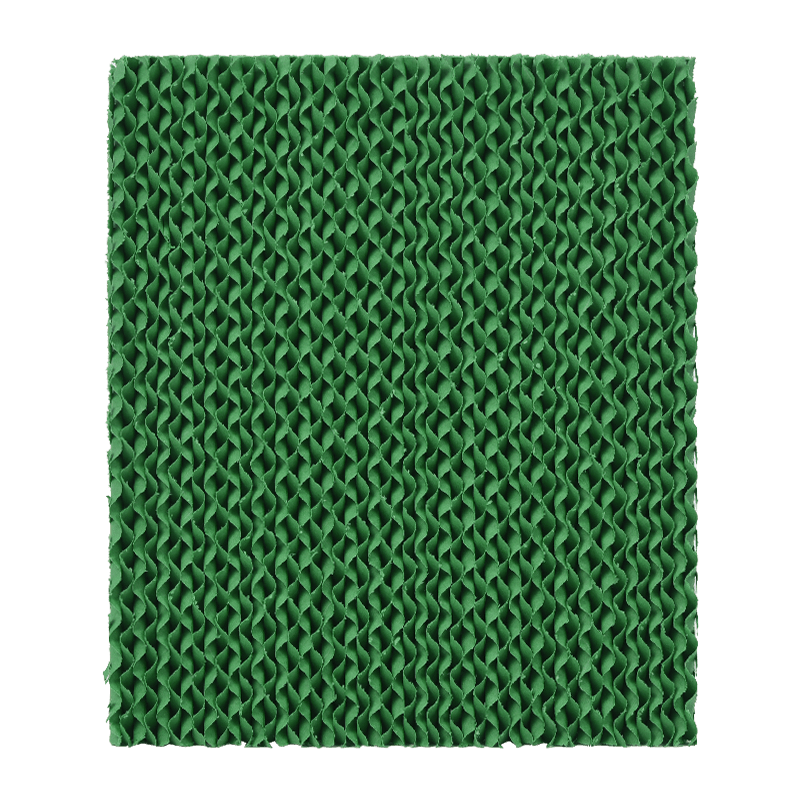 7090 Greenhouse Honeycomb Evaporative Cooling PadWith 7 mm flutes and a 45° groove angle, this pad reduces pressure drop, making it ideal for greenhouses that need uniform cooling at low face velocities and high humidity.View Product →
Poultry and Livestock
Poultry houses need high air exchange rates while keeping relative humidity in a safe range. The 6090 specification works well where pads operate continuously at high air volumes.
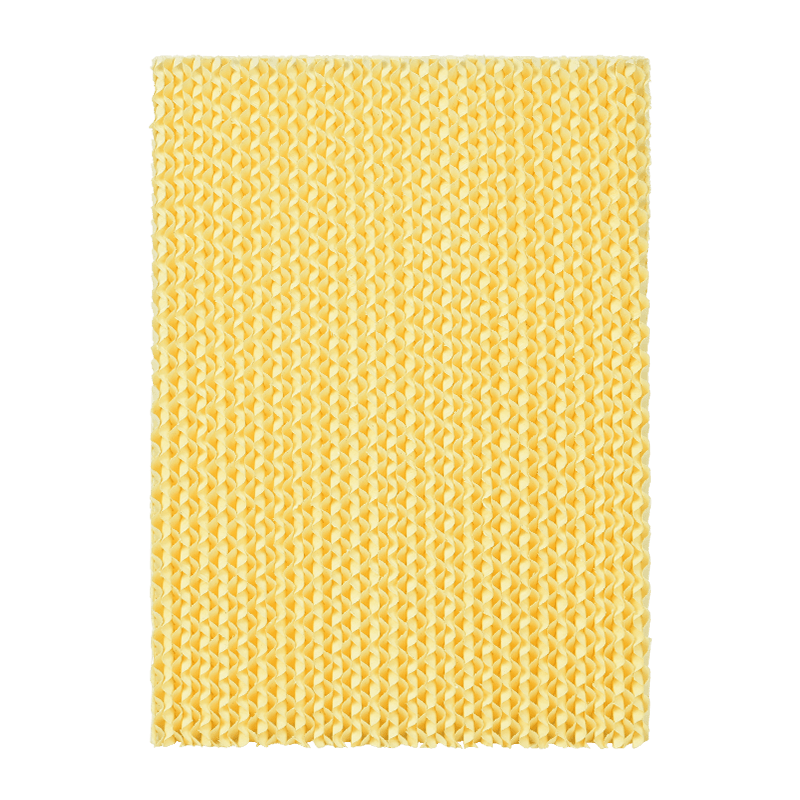 6090 Poultry Equipment Evaporative Cooling PadDesigned for poultry houses, this 6 mm flute pad operates continuously at high air volumes, supporting high air exchange rates while managing relative humidity within safe ranges.View Product →
Industrial and Commercial
In factories and commercial spaces, the goal is to keep working conditions tolerable without over-humidifying machinery or materials. Here the decision is usually between pad thickness and face velocity rather than material.
Pad Thickness: 30%
Air Velocity: 25%
Water Distribution: 20%
Pad Material: 15%
Maintenance: 10%
Frequently Asked Questions
What is a good saturation efficiency for a cooling pad?
Above 85% is considered excellent for a rigid cellulose pad at its design face velocity. Above 90% is achievable in well-maintained systems. Below 70% usually indicates a mismatch between pad thickness and airflow, or a pad that needs cleaning or replacement.
How does saturation efficiency change with face velocity?
It drops as face velocity rises. Doubling face velocity from 1.0 to 2.0 m/s can reduce saturation efficiency by 10 to 20 percentage points, depending on pad thickness and material.
Does outdoor humidity affect saturation efficiency?
Yes. Wet-bulb depression shrinks as outdoor humidity rises. Even a 90% efficient pad will deliver less temperature drop on a humid day. Saturation efficiency is a performance percentage, not a fixed temperature drop.
How does pad thickness relate to saturation efficiency?
Thicker pads generally achieve higher saturation efficiency because the air stays in contact with the wetted surface longer. However, static pressure also increases, which affects fan selection and energy use.
Saturation efficiency links pad geometry, airflow, water distribution, and material into one actionable number. Before buying a cooling pad, ask for efficiency data at the face velocity your system actually runs at. That single question helps you avoid oversized fans, undersized pads, and years of excess energy cost.
Ready to evaluate a pad for your system? Browse our evaporative cooling pad range or contact our team for help matching the right specification to your environment.

 CONTACT US