
 EN
EN  English
 中文简体
中文简体 عربى
عربى Tiếng Việt
Content
- 1 Corrugation Structure Parameters and Heat Exchange Performance Comparison
- 2 Evaporative Cooling Efficiency and Temperature Reduction Analysis
- 3 Air Resistance Characteristics and Fan Energy Consumption Correlation
- 4 Precise Matching of Applicable Scenarios and Industry Applications
- 5 Production Process and Quality Control Differences
- 6 Maintenance Costs and Service Life Assessment
- 7 Procurement Decision Recommendations and Common Selection Misconceptions
- 8 Industry Trends: Intelligent Pads and Adaptive Structures
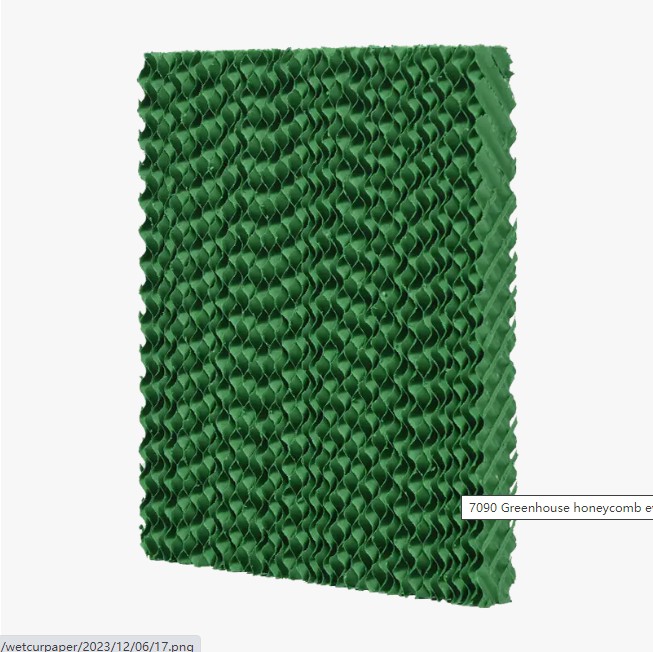
After comparing the 5090 honeycomb pad and the 7090 greenhouse honeycomb pad, it was found that the 5090 type, with its 5mm flute height and 30°/60° cross-corrugation angle, achieves a heat exchange area of 175-230m²/m³ per unit volume with saturation efficiency as high as 80%-92%, making it the preferred choice for high-temperature large spaces such as industrial plants and livestock farming. Meanwhile, the 7090 type adopts a 7mm flute height and standard 45°/45° angle, with a heat exchange area of approximately 150-200m²/m³ and saturation efficiency of 75%-85%. However, its larger channel cross-section reduces air resistance by approximately 20%-30% while delivering higher ventilation volume, making it better suited for the stringent demands of greenhouses for uniform airflow and low-energy ventilation. Selection errors will lead to surging fan energy consumption or insufficient cooling performance; precise matching based on spatial characteristics and fan parameters is essential.
Corrugation Structure Parameters and Heat Exchange Performance Comparison
The following table provides a side-by-side technical comparison of the two pads across five core dimensions: flute height, corrugation angle, heat exchange area, saturation efficiency, and air resistance coefficient.
| Comparison Dimension | 5090 Honeycomb Pad | 7090 Greenhouse Honeycomb Pad |
|---|---|---|
| Flute Height | 5mm | 7mm |
| Corrugation Angle | 30°/60° Cross-corrugation | 45°/45° Cross-corrugation |
| Heat Exchange Area per Unit Volume | 175-230m²/m³ | 150-200m²/m³ |
| Saturation Efficiency | 80%-92% | 75%-85% |
| Air Resistance Coefficient | Higher (narrow channels) | Lower (wide channels) |
| Standard Thickness | 100mm/150mm/200mm | 100mm/150mm/200mm |
| Fan Static Pressure Requirement | High, requires high-pressure fan | Moderate, standard fan sufficient |
Evaporative Cooling Efficiency and Temperature Reduction Analysis
5090 Pad: Maximum Efficiency from High Heat Exchange Area
The 5090 pad's 5mm flute height and 30°/60° cross-corrugation angle create a denser heat exchange surface per unit volume. Under typical dry conditions of 38℃ ambient temperature and 20% relative humidity, with air passing through a 150mm thick pad at 2.0m/s face velocity, the 5090 type achieves saturation efficiency of 85%-92%, with outlet temperature dropping to approximately 21-23℃—an actual cooling range of 10-16℃. This efficiency advantage is particularly critical in heat-intensive industrial plants. In welding workshops and foundries where ambient temperatures often reach 42℃ and above, the 5090 pad paired with fans of 450W and above can stabilize working area temperatures below 28℃ across 200㎡ spaces, ensuring worker safety and normal equipment operation.
7090 Pad: Balanced Efficiency Prioritizing Ventilation
The 7090 pad's 7mm flute height provides more spacious airflow channels. Although its heat exchange area per unit volume is approximately 15%-20% lower than the 5090 type, its saturation efficiency under typical greenhouse conditions (35℃ ambient temperature, 40%-60% relative humidity) still reaches 75%-85%. Outlet temperature is approximately 26-28℃, with a cooling range of 6-10℃. For greenhouses, this cooling range is sufficient to control summer internal temperatures from dangerous levels above 40℃ to the crop-suitable range of 30-32℃. More importantly, the 7090 pad's low pressure-drop characteristics allow fans to maintain required ventilation volume at lower speeds, achieving annual electricity savings of 20%-30% in year-round greenhouse operation scenarios.
Air Resistance Characteristics and Fan Energy Consumption Correlation
Air resistance is the critical bridge connecting pad selection to system energy consumption. The difference between the two pads in this metric directly determines supporting fan power configuration and operating costs.
| Comparison Dimension | 5090 Honeycomb Pad | 7090 Greenhouse Honeycomb Pad |
|---|---|---|
| 150mm Pad Air Resistance (2.0m/s face velocity) | Approx. 45-55Pa | Approx. 30-40Pa |
| Recommended Fan Static Pressure | 120-180Pa | 80-120Pa |
| Supporting Fan Power (at equal airflow) | Higher, approximately 20%-30% increase | Standard configuration |
| Annual Operating Energy Difference (8h/day, 6 months) | Approx. 300-500 kWh higher | Baseline level |
Engineering Significance of Air Resistance Differences
The 5090 pad's narrow channels (5mm flute height) significantly increase air flow friction resistance while boosting heat exchange area. Taking 150mm thickness and 2.0m/s face velocity as examples, the 5090 type has air resistance of approximately 45-55Pa, while the 7090 type is only 30-40Pa. This means that to maintain equal ventilation volume, the 5090 system requires fans with higher static pressure, typically increasing fan power by 20%-30%. In industrial scenarios, this energy increment is offset by superior cooling performance. However, in greenhouse scenarios where ventilation systems operate year-round and are highly sensitive to energy consumption, the 7090 type's low pressure-drop advantage makes it the more economical choice. Conversely, forcing the 7090 type into industrial scenarios may reduce fan energy consumption but result in insufficient cooling that forces extended equipment runtime, potentially driving overall energy costs higher.
Precise Matching of Applicable Scenarios and Industry Applications
Core Battlegrounds for the 5090 Pad
- High-Temperature Industrial Plants: Welding, casting, and heat treatment workshops where ambient temperatures often reach 42-45℃. The 5090 pad's 80%-92% saturation efficiency ensures outlet temperatures below 28℃, creating safe working conditions for operators
- Livestock Farming Sheds: Pig houses and chicken coops where summer heat stress is a major cause of livestock mortality. The 5090 pad paired with high-power negative-pressure fans can achieve 10-15℃ cooling across farming areas exceeding 200㎡, effectively reducing heat stress losses
- Commercial Spaces in Dry Regions: Shopping malls and internet cafes in northwest and north China where relative humidity is below 30%. The 5090 pad's evaporation efficiency can be fully utilized with cooling ranges of 12-16℃
- Data Center Auxiliary Cooling: Evaporative cooling pre-cooling systems for server room peripherals. The 5090 type's high efficiency can reduce fresh air temperature by 8-12℃ before it enters the air conditioning system, significantly reducing precision air conditioning load
Comfort Zones for the 7090 Pad
- Greenhouses: Vegetable and flower seedling greenhouses with extremely high requirements for temperature uniformity. The 7090 pad's low air resistance ensures more even air distribution, avoiding local overcooling or overheating while reducing year-round ventilation energy consumption by 20%-30%
- Edible Fungi Cultivation: Mushrooms and wood ear fungi are extremely sensitive to humidity and airflow velocity. The 7090 pad's gentle airflow prevents mechanical damage to mycelium while maintaining high humidity environments of 85%-90%
- Moderate Humidity Regions: East and south China where relative humidity is 50%-70%. The 7090 pad's larger channels reduce condensation risks in high-humidity environments, preventing mold growth on pad surfaces
- Energy-Efficient Warehousing: Logistics warehouses sensitive to operating costs. The 7090 pad paired with low-power fans meets basic cooling needs and can replace traditional air conditioning during transitional seasons with significant energy savings
Production Process and Quality Control Differences
Six-Level Quality Control System for 7090 Greenhouse Pads
The 7090 greenhouse honeycomb pad production process implements a strict six-level quality control system: raw material inspection involves chemical composition analysis of hardeners, preservatives, and adhesives to ensure performance and safety compliance; production process monitoring tracks workshop temperature, humidity, and air quality in real time, with regular equipment calibration to ensure accuracy; standard operating procedures (SOP) cover every aspect from material preparation to molding; finished product testing includes multiple performance tests for airflow, water absorption, and heat exchange efficiency; aging and corrosion resistance tests simulate long-term use environments; each batch undergoes sampling inspection before factory release with quality reports generated. This complete quality control chain enables the 7090 type to achieve industry-leading qualification rates, particularly suitable for greenhouse year-round operation scenarios with high reliability requirements.
Precision Manufacturing Requirements for 5090 Pads
The 5090 pad, with its mere 5mm flute height, has more stringent requirements for forming precision. Each intersection node of the honeycomb structure must maintain consistent height; otherwise, uneven airflow distribution and local short-circuiting will occur. The production process uses imported kraft paper (95g/㎡ or 105g/㎡ options), with tensile resistance reaching 70N, water absorption height of 45mm/10min, and moisture content controlled at 5%-8%. A 600mm wide pad contains 85 corrugated sheets, with inter-sheet spacing error required to be less than 0.3mm. Any deviation directly impacts heat exchange efficiency. The 5090 type contains no phenol or other allergenic chemical substances, meeting human safety and environmental requirements, providing natural advantages in food processing and public space applications.
Maintenance Costs and Service Life Assessment
Water Quality Requirements and Scaling Risk Differences
The 5090 pad's 5mm narrow channels are extremely sensitive to water hardness. Under water source conditions with total hardness exceeding 300mg/L, calcium and magnesium ion deposits will rapidly clog channels, increasing air resistance by over 50% within 3-6 months and reducing saturation efficiency by 10-15 percentage points. It is recommended that 5090 systems must be equipped with water softening devices or pre-filters. The 7090 pad's 7mm channels have higher tolerance for water quality, capable of normal operation for 1-2 years without special treatment under source conditions with total hardness below 450mg/L. For users with poor water quality conditions who cannot install water treatment equipment, the 7090 type is the more practical choice.
Cleaning Frequency and Replacement Cycle
Both pads should be cleaned every 2-4 weeks using soft brushes or low-pressure water jets to remove surface scale and algae. Under normal tap water conditions, the 5090 pad has a service life of 2-3 years, while the 7090 pad lasts 3-5 years. The gap primarily stems from the 5090 type's narrow channels being more prone to mineral deposit accumulation, and the continuous airflow冲刷 from high-pressure fans accelerating material aging. In greenhouse scenarios, the 7090 pad's gentle ventilation and low air pressure result in significantly slower material wear compared to the 5090 type in industrial scenarios. Users in high-dust environments are advised to shorten cleaning cycles to every 1-2 weeks to extend effective pad lifespan.
Procurement Decision Recommendations and Common Selection Misconceptions
Four-Step Selection Decision Method
- Evaluate Ambient Temperature and Humidity: Ambient temperatures exceeding 40℃ with relative humidity below 30% favor the 5090; temperatures of 35-40℃ with relative humidity of 40%-60% make the 7090 more balanced
- Confirm Fan Parameters: When existing fan static pressure is below 120Pa, forcing the 5090 will result in insufficient airflow—the 7090 should be selected. If fans can be upgraded, the 5090's cooling returns justify the investment
- Test Water Source Hardness: Total hardness exceeding 300mg/L with no water treatment budget makes the 7090 type more adaptable. With good water quality (TDS below 200mg/L), the 5090's efficiency advantages can be fully realized
- Calculate Total Lifecycle Costs: The 5090 type has higher initial procurement and fan matching costs, but its superior cooling performance in high-temperature industrial scenarios reduces equipment downtime losses. The 7090 type has lower initial costs and energy consumption, suiting budget-conscious users
Common Selection Misconceptions Warning
Misconception One: "Larger heat exchange area is always better; use 5090 for all scenarios." Using 5090 pads in greenhouses forces fans to run at higher power due to high air resistance, increasing annual energy consumption by 300-500 kWh, and strong airflow may cause mechanical damage to seedlings. Misconception Two: "7090 is cheaper and saves energy, so it can work in industrial scenarios too." In foundries above 42℃, the 7090 pad's 75%-85% saturation efficiency cannot reduce temperatures to safe thresholds, significantly increasing worker heatstroke risk and equipment overheating failure rates. Misconception Three: "Pad thickness doesn't matter much; 100mm and 200mm are about the same." Pad thickness must be strictly matched to fan static pressure—100mm thick 5090 pads require fans above 120Pa, while 200mm thick pads need fans above 180Pa. Blindly thickening without sufficient pressure causes air short-circuiting, potentially reducing actual efficiency below 100mm configurations.
Industry Trends: Intelligent Pads and Adaptive Structures
The evaporative cooling pad industry is evolving from "fixed parameters" to "dynamic adaptation." New-generation variable-pore pads can automatically adjust channel opening based on water quality sensor data—widening channels in hard water environments to prevent clogging and narrowing them in soft water environments to boost efficiency, enabling a single product to simultaneously achieve the 5090's high efficiency and the 7090's low air resistance. In IoT integration, pad systems are connecting to intelligent greenhouse management platforms, predicting clogging trends through real-time monitoring of inlet/outlet air temperature and humidity, pressure differential, and water quality TDS values, enabling 7-14 day advance maintenance warnings that reduce unplanned downtime by 50% and above. At the material level, nano antibacterial coatings and photocatalytic self-cleaning technologies enable pads to maintain evaporation efficiency while possessing bactericidal and anti-mold functions, further reducing maintenance frequency. For buyers, understanding the fundamental differences between 5090 and 7090 is the first step toward intelligent selection.

 CONTACT US