
 EN
EN  English
 中文简体
中文简体 عربى
عربى Tiếng Việt
Content
- 1 Why Pad Size Controls the Whole System
- 2 The Greenhouse Cooling Pad Size Formula
- 3 Step-by-Step Worked Example
- 4 4-Inch or 6-Inch Pads: Which One to Choose
- 5 Temperature Gradient: Why the Far End Is Always Warmer
- 6 Water Flow and Sump Sizing
- 7 Common Sizing Mistakes That Ruin Cooling Performance
- 8 Frequently Asked Questions
- 9 Final Sizing Checklist
By 11 a.m. on a clear July day, the temperature inside a 40 x 100 ft greenhouse can climb past 38°C even with side vents open. After installing exhaust fans and an evaporative cooling pad, a grower expects the incoming air to drop to around 27°C. When that does not happen, the common response is to add another fan. In most real cases, the problem is not fan capacity. It is a cooling pad area that does not match the airflow moving through the house.
Cooling pad sizing is a straightforward engineering calculation. It combines the greenhouse ventilation rate with the maximum air velocity the pad medium can handle. This guide covers the standard formula, the reference values used by designers, a step-by-step worked example, and the sizing mistakes that push temperatures up even when the system appears to be running correctly.
Why Pad Size Controls the Whole System
Here is the conclusion up front: the pad area determines the face velocity, which is the speed of the air entering the wet pad surface. Evaporative cooling depends on enough contact time between the air and the wet cellulose. When the pad is too small, air passes through too fast, cooling efficiency drops, and water droplets are pulled into the crop. When the pad is too large, you overpay for material and struggle to wet the pad evenly.
- Pad too small: face velocity above 350 fpm, water carryover, and warm, humid air at the fan end.
- Pad too large: extra cost, dry spots, and uneven evaporation across the pad face.
- Pad correctly sized: stable face velocity in the 250 to 350 fpm range and a predictable temperature rise.
The Greenhouse Cooling Pad Size Formula
Only two numbers are required: the total airflow the greenhouse needs, and the recommended face velocity of the pad.
Airflow: start with the floor area
The standard design rate for fan-and-pad cooling in greenhouses is 8 CFM per square foot of floor area, which corresponds to roughly one air change per minute. Multiply the floor length by the floor width and then by 8. A 40 x 100 ft greenhouse, for example, has 4,000 sq ft of floor, so the total airflow is 4,000 x 8 = 32,000 CFM.
Face velocity: match the pad type
Face velocity is the speed of air as it enters the pad. The values used by greenhouse designers are 250 fpm for 4-inch cellulose pads, 350 fpm for 6-inch cellulose pads, and about 140 fpm for aspen pads. Do not use 350 fpm when planning a 4-inch pad.
| Pad type | Face velocity (fpm) | Air handled per sq ft (CFM) | Typical use |
|---|---|---|---|
| 4-inch cellulose | 200 to 250 | 250 | Smaller houses and retrofits |
| 6-inch cellulose | 300 to 350 | 350 | Standard large greenhouses |
| Aspen (excelsior) | 100 to 140 | 140 | Budget systems, short lifespan |
Step-by-Step Worked Example
Apply the formula to a 40 x 100 ft greenhouse with a 10 ft gutter and an average roof height of 14 ft. The floor area controls the airflow, not the peak height, so the calculation stays simple.
Step 1: floor area
40 x 100 = 4,000 sq ft.
Step 2: total airflow
4,000 sq ft x 8 CFM per sq ft = 32,000 CFM. At elevations above 3,000 ft, multiply by 1.05 to 1.15; this example assumes low elevation.
Step 3: pad area
32,000 ÷ 350 = 91.4 sq ft. Round to 92 sq ft of 6-inch pad. With a 4-inch pad, the area would be 32,000 ÷ 250 = 128 sq ft.
Step 4: convert area to wall dimensions
Subtract the structural frame, louvers, and installation gaps from the wall width to get the usable pad run. On a 40 ft wall, about 4 ft is lost to framing, leaving 36 ft. Pad height = 92 ÷ 36 = 2.6 ft, or about 31 inches. For a standard 4 ft pad height, the required pad run would be 92 ÷ 4 = 23 ft.
Growers with smaller houses sometimes prefer a 5090 honeycomb cooling pad and hold the face velocity near 250 fpm in the design.
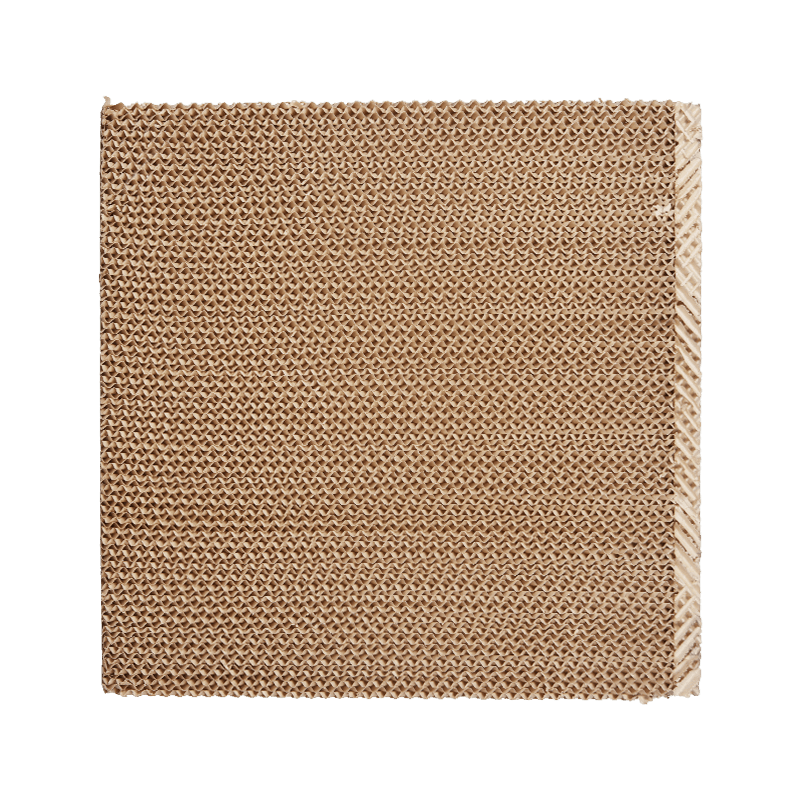 Wholesale 5090 Honey Comb Cooling pads Suppliers, OEM/ODM Company - Qisheng PapeQisheng Paper Products Co., Ltd is China OEM/ODM 5090 Honey Comb Cooling pads suppliers and 5090 Honey Comb Cooling pads company, We spec...View Product →
4-Inch or 6-Inch Pads: Which One to Choose
The pad thickness changes the design. A 6-inch pad allows a higher face velocity because air travels a longer path through the fluted channels, improving evaporative contact. That is why the required area is smaller with 6-inch pads.
| Criterion | 4-inch pad | 6-inch pad |
|---|---|---|
| Design face velocity | 250 fpm | 350 fpm |
| Pad area for 32,000 CFM | 128 sq ft | 92 sq ft |
| Typical cooling efficiency | About 75 percent | About 85 percent |
| Pressure drop | Lower | Higher |
| Best suited to | Small houses and retrofits | Large or long greenhouses |
Nearly all commercial greenhouses use 6-inch cellulose because it tolerates higher incoming air temperature and needs a smaller wall opening for the same airflow. For a greenhouse application, choose a rigid, self-supporting pad such as the 7090 greenhouse honeycomb evaporative cooling pad. Its structure keeps the flutes open when wet, so the pad holds the airflow rate assumed in the sizing calculation. You can also read more about how the honeycomb design affects heat dissipation.
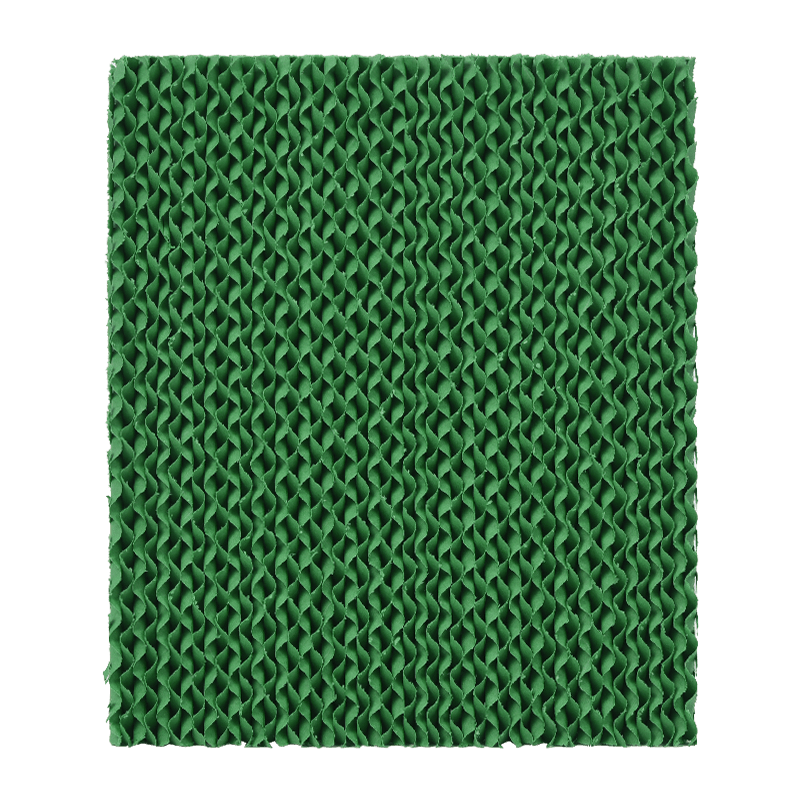 Wholesale 7090 Greenhouse honeycomb evaporative cooling pad Suppliers, OEM/ODM CQisheng Paper Products Co., Ltd is China OEM/ODM 7090 Greenhouse honeycomb evaporative cooling pad suppliers and 7090 Greenhouse honeycom...View Product →
Temperature Gradient: Why the Far End Is Always Warmer
In a fan-and-pad system, air warms up as it travels from the pad wall to the exhaust fans. A rise of 5 to 8°F across a 100 ft house is normal even with correctly sized pads. The chart below shows a typical profile.
The practical implication: for houses longer than 120 to 150 ft, either install a second pad wall in the middle or reduce the distance between the pad and the fans. Sizing calculators treat this as a pad-to-fan distance factor, and it is one of the reasons a simple floor-area formula is only a starting point.
Water Flow and Sump Sizing
The pad area also determines the pump capacity. For 6-inch cellulose pads, design the water flow at 0.5 to 0.8 GPM per linear foot of pad. For 4-inch pads, 0.3 to 0.5 GPM per linear foot is common.
In the worked example, the pad run is 36 ft, so the pump should deliver at least 36 x 0.5 = 18 GPM, and preferably up to 36 x 0.8 = 28.8 GPM. Choose a pump near the upper end so the top of the pad stays fully wetted.
The sump tank should hold about 1 gallon per square foot of pad area. For 92 sq ft of pad, use a 90 to 100 gallon sump. A larger sump keeps the water temperature lower and reduces evaporation losses from the tank itself.
Common Sizing Mistakes That Ruin Cooling Performance
These four errors account for most cooling problems in fan-and-pad greenhouses:
- Forgetting to subtract the frame: the pad area must be calculated on the actual pad run, not the wall width.
- Mixing pad thickness in the formula: using 350 fpm for a 4-inch pad or 250 fpm for a 6-inch pad gives the wrong area.
- Ignoring elevation: above 3,000 ft, apply an elevation factor of about 1.05 to 1.15 to the airflow.
- Blocking airflow: pulling shade cloth or insect screen directly against the pad raises face velocity and causes water carryover.
Even a correctly sized pad loses performance over time. Mineral scale, algae, and uneven water distribution slowly reduce the effective pad area. The breakdown below shows the typical causes of pad performance loss in operating greenhouses.
- Mineral scale, 35%
- Uneven water distribution, 25%
- Algae and debris, 20%
- Air bypass around pads, 20%
Frequently Asked Questions
What happens if my cooling pad is too small?
Air passes through too fast, water is pulled into the greenhouse, and cooling efficiency drops. The far end of the house stays warm and humid, which is exactly the condition that causes heat stress in crops.
Can I use 4-inch pads instead of 6-inch in a large greenhouse?
Yes, but you need about 40 percent more pad area. Wall height usually limits the pad height, so most large houses end up with 6-inch pads.
How do I determine the pad height?
Divide the required pad area by the usable pad run. A 92 sq ft pad over a 36 ft run needs a height of about 2.6 ft.
Should I add a safety margin to the pad area?
A margin of 5 to 10 percent is reasonable. Doubling the area creates dry spots because the water flow per square foot becomes too low.
How long does a greenhouse cooling pad last?
With clean water and regular cleaning, a 6-inch cellulose pad typically lasts 3 to 5 years. Hard water, algae, and direct sunlight shorten this life.
Final Sizing Checklist
Before you order pads or build the pad wall, confirm these numbers:
- Airflow: floor area x 8 CFM = total CFM.
- Pad area: total CFM ÷ face velocity (350 fpm for 6-inch, 250 fpm for 4-inch).
- Usable pad run: wall width minus framing.
- Pad height: pad area ÷ usable pad run.
- Pump: 0.5 to 0.8 GPM per linear foot of pad.
- Sump: about 1 gallon per square foot of pad area.
The whole calculation takes five minutes, but it prevents months of undersized cooling. If you are planning a new greenhouse or replacing an existing pad wall, contact our team with your greenhouse dimensions and pad preference. We can help you verify the pad area before you place the order.

 CONTACT US