
 EN
EN  English
 中文简体
中文简体 عربى
عربى Tiếng Việt
Content
- 1 What the 7090 Designation Means and Why It Matters for Longevity
- 2 How the 7090 Pad Works: The Evaporative Cooling Mechanism
- 3 Manufacturing Treatments That Extend 7090 Pad Service Life
- 4 Factors That Determine Actual Service Life in Greenhouse Use
- 5 Signs That a 7090 Pad Has Reached the End of Its Service Life
- 6 Maintenance Practices That Maximize 7090 Pad Service Life
A well-maintained 7090 greenhouse honeycomb evaporative cooling pad has a typical service life of 5 to 10 years under normal greenhouse operating conditions. The "7090" designation refers to the pad's cell geometry — 70 mm deep with a 90° flute angle — which is the most widely used configuration in commercial greenhouse cooling systems. Service life is not fixed by the pad material alone; it is determined by the interaction of water quality, operating hours, maintenance practices, and the chemical treatments applied during manufacturing. Pads treated with hardeners, preservatives, and special odorless binders — as used in quality-grade 7090 pads — consistently outlast untreated cellulose pads by a factor of two to three in field conditions.
What the 7090 Designation Means and Why It Matters for Longevity
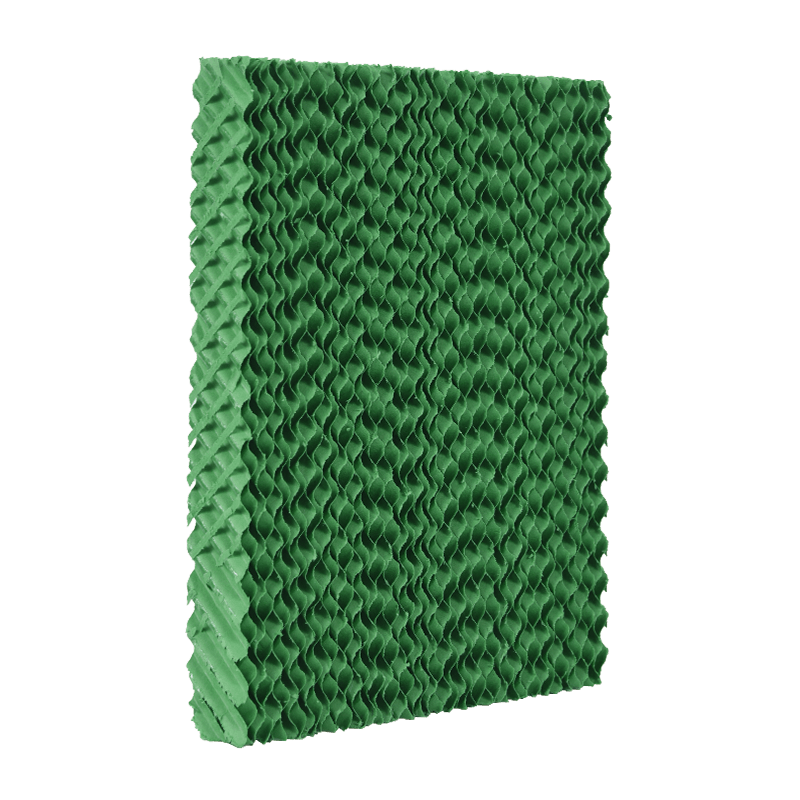
The 7090 specification defines two critical geometric parameters of the honeycomb pad that directly influence both cooling efficiency and structural durability throughout its service life.
- 70 mm pad depth — the airflow path length through the pad. A deeper pad provides more surface area for water-to-air contact, increasing evaporative cooling efficiency. For a greenhouse with fans pulling air through the pad, a 70 mm depth achieves a temperature drop of 8–12°C in hot, dry conditions (relative humidity below 40%), significantly more than the 45 mm alternative.
- 90° flute angle — the crossing angle of the corrugated cellulose flutes within the pad. The 90° configuration creates a more open cell structure than the 45° variant, which reduces the rate of mineral scale accumulation within the cell channels — one of the primary mechanisms that shortens pad service life. The more open geometry also allows the pad to drain and dry more completely between operating cycles, reducing the mold and algae growth that degrades structural integrity.
Compared to the 5090 pad (50 mm deep, 90° angle), the 7090 provides greater cooling capacity per unit of face area but requires slightly higher fan static pressure — typically 2–4 Pa additional resistance — due to the longer airflow path through the deeper media.
How the 7090 Pad Works: The Evaporative Cooling Mechanism
Understanding the operating mechanism of the 7090 pad explains why certain operating conditions accelerate wear and how proper management extends service life.
Hot outside air is drawn through the pad by greenhouse exhaust fans mounted on the opposite wall. A water distribution header at the top of the pad continuously trickles water down through the honeycomb cell structure, keeping the entire pad surface wet. As the warm, dry air passes through the wetted pad channels, water molecules on the cellulose fiber surface absorb latent heat from the airstream and evaporate into it — a process called adiabatic evaporative cooling. This transfers heat energy from the air into water vapor, reducing the dry bulb temperature of the air while increasing its moisture content. The cooled, humidified air then enters the greenhouse, reducing the internal temperature.
The water that does not evaporate drains to a sump tank at the base of the pad and is recirculated by a pump back to the distribution header. This recirculation loop is the primary pathway through which dissolved minerals — calcium, magnesium, silica, and other salts — concentrate in the recirculating water over time and deposit as scale within the pad cells. Scale accumulation is the leading cause of reduced pad service life, progressively blocking cell channels, reducing airflow, and adding mechanical stress to the cellulose structure as mineral crystals grow within the fiber matrix.
Manufacturing Treatments That Extend 7090 Pad Service Life
Quality 7090 greenhouse cooling pads are manufactured from cross-corrugated cellulose paper that has been impregnated with a series of chemical treatments specifically designed to extend structural life and resist the biological and chemical degradation mechanisms encountered in continuous greenhouse operation.
Hardener Treatment
The cellulose fiber structure is impregnated with thermosetting resin hardeners that penetrate the paper matrix and crosslink under heat during manufacturing, converting the inherently soft, water-absorbent paper into a rigid, dimensionally stable honeycomb structure. Without hardener treatment, a cellulose pad would swell, distort, and structurally collapse within weeks of continuous water contact. Hardened pads maintain their cell geometry — and therefore their airflow resistance and cooling performance — throughout their full service life even under continuous wet-dry cycling.
Preservative Treatment
Biocide preservatives incorporated into the pad during impregnation inhibit the growth of algae, fungi, and bacteria within the wet cellulose matrix. In a greenhouse environment with high humidity, nutrients from plant dust and fertilizer residues in the air and recirculating water create ideal conditions for rapid microbial colonization of an untreated pad. Biological growth blocks cell channels (reducing airflow), produces odors detectable in the greenhouse, and enzymatically degrades the cellulose fiber, causing accelerated structural breakdown. Preservative-treated pads resist this biological attack, maintaining both performance and structural integrity for the full rated service life.
Special Odorless Binder
The cross-corrugated layers of the honeycomb structure are bonded at their contact points with a specially formulated odorless binder that is both water-resistant and compatible with the greenhouse environment. The odorless specification is critical because any volatile compounds released from the binder into the air stream would be carried directly into the greenhouse and could negatively affect plant health or produce quality — a concern that does not arise with industrial evaporative cooler pads but is a strict requirement for horticultural applications. The binder's water resistance ensures that the structural bonds between corrugated layers do not soften or dissolve under continuous water flow, preventing the delamination and collapse that terminates pad service life in lower-quality products.
Factors That Determine Actual Service Life in Greenhouse Use
The 5–10 year service life range for quality 7090 pads reflects the wide variation in actual operating conditions. The following factors determine where a specific installation falls within — or outside — this range.
| Factor | Effect on Service Life | Best Practice |
|---|---|---|
| Water hardness (mineral content) | High hardness (>300 ppm CaCO₃) accelerates scale buildup, blocking cells and adding structural stress | Maintain sump conductivity below 1,500 µS/cm; bleed off recirculating water regularly |
| Annual operating hours | More hours = more wet-dry cycles and mineral concentration events; proportionally shorter life | Run system only when cooling is needed; avoid unnecessary operation in mild weather |
| Dry-out between seasons | Pads left wet during winter encourages mold, frost damage, and structural degradation | Drain system completely and allow pads to dry thoroughly before seasonal shutdown |
| Pad cleanliness | Accumulated dust, debris, algae, and mineral deposits reduce airflow and add weight stress | Rinse pads with clean water at the start and end of each cooling season; clean sump monthly |
| Water distribution uniformity | Dry spots cause rapid localized scale buildup and differential thermal stress that cracks the pad structure | Inspect and clear distribution header nozzles at the start of each season |
| UV and sunlight exposure | Direct sun on pad face causes surface photo-oxidation and accelerated surface fiber degradation | Install shade screen over pad exterior face or select UV-stabilized pad grades where available |
Signs That a 7090 Pad Has Reached the End of Its Service Life
Rather than replacing pads on a fixed calendar schedule, the most practical approach is to monitor the pad's condition and performance against the following indicators. A pad showing two or more of these signs should be replaced before the next cooling season to avoid reduced greenhouse temperature control and potential crop losses during peak summer heat.
- Visible structural collapse or sagging — sections of the pad that have buckled, separated from the frame, or visibly collapsed indicate that the hardener-treated cellulose structure has degraded beyond recovery. Collapsed sections allow air to bypass the wet media, eliminating evaporative cooling from that area.
- Heavy white or grey mineral crust on cell faces — a light surface deposit is normal and can be rinsed off; a thick, hard crust covering more than 20–30% of the cell openings indicates irreversible mineral blockage that cannot be removed without damaging the pad structure.
- Reduced cooling performance despite correct fan operation — if the temperature difference between outside air and air entering the greenhouse has dropped by more than 2–3°C from the pad's original performance, and water distribution and fan operation are confirmed normal, the pad media has degraded and replacement is needed.
- Persistent odor from the air stream — unpleasant or musty odors indicate active microbial colonization that the preservative treatment can no longer suppress. In a greenhouse, odors from the cooling pad can stress sensitive plant species and indicate a hygiene concern that warrants immediate pad replacement.
- Fiber surface crumbling or shedding — if the pad surface sheds cellulose fibers when gently touched or when water flows through it, the hardener treatment has failed and the structural life of the pad is exhausted.
Maintenance Practices That Maximize 7090 Pad Service Life
The difference between a 7090 pad lasting 5 years and one lasting 10 years in the same climate is almost entirely determined by maintenance practices. The following routine procedures are low in cost and labor but have a disproportionate impact on pad longevity.
- Regular sump bleed-off — drain and refill 10–15% of the sump volume daily during the operating season in hard water areas. This dilutes the mineral concentration in the recirculating water, slowing scale deposition in the pad cells. In soft water areas (below 150 ppm), weekly bleed-off may be sufficient.
- Clean low-pressure rinse at season start and end — rinse the pad face with a garden hose at low pressure (never a pressure washer) to dislodge surface dust and loose mineral deposits. High-pressure water damages the cellulose fiber surface and shortens pad life significantly.
- Sump and distribution header cleaning — clean the sump tank and clear all distribution header nozzles at the start of each season. Algae and debris in the sump are the primary reservoir for the biological contamination that later colonizes the pad.
- Complete dry-out before seasonal shutdown — run the fans without the water pump for 1–2 hours at the end of the cooling season to thoroughly dry the pad before winter. Store the pads dry to prevent frost damage to the wetted cellulose structure and biological growth during the dormant period.
- Inspect and resecure pad frames — loose or bent pad frames allow air gaps around pad edges that reduce cooling efficiency and concentrate airflow through central pad sections, accelerating localized wear. Check frame seals and fasteners annually.

 CONTACT US